Non-Profit AI Subscription Cost — Making Smart Choices on a Budget

We know how it feels—running your non-profit isn’t easy. You’re passionate about your mission. You stretch every dollar and pour your heart into making a difference. You do so much work that sometimes it feels like the day needs more hours. Tight budgets, donor expectations, endless to-do lists, fundraising, volunteer management, and outreach, to name a few. Sure, it’s only natural that you thought of adopting AI tools, but then you might have wondered about the non-profit AI subscription cost, “It’s a luxury only for Fortune 500 companies,” and might have brushed off that idea immediately.  

However, there is something you need to know. AI isn’t solely just for tech giants. AI is also transforming how non-profits operate, saving time and resources that could be better spent on your mission. Over 60% of smaller nonprofits, those making under $1 million, are exploring AI to help with things like grant writing, reaching out to donors, and handling admin tasks. Let’s talk about non-profit AI subscription cost and how your small non-profit can make smart choices on a budget and have the same impact. 

Understanding AI Subscription Services for Non-Profits
AI subscription services can significantly streamline non-profit operations. Here’s how these tools can help:

  • ChatGPT (OpenAI): Acts as your personal writing assistant, creating fundraising emails, social media content, and grant proposals quickly and efficiently.
  • Claude (Anthropic): Offers conversational AI focusing on ethical engagement, perfect for engaging donors and volunteers in a way that feels good and responsible.
  • Gemini (Google DeepMind): Provides multimodal capabilities, analyzing text and images together for a deeper understanding of donor behavior and campaign effectiveness.
  • Grok (X.AI by Elon Musk): Aids in real-time scheduling and task management to streamline collaboration and reduce administrative burdens.
  • Amazon Comprehend: Utilizes natural language processing to analyze donor feedback, enhancing engagement strategies with actionable insights.

In addition to these, a new player, CollabAI, is making waves with its non-profit-focused platform.

Introducing CollabAI: Custom AI for Non-Profits
CollabAI is designed specifically with the needs of non-profit organizations in mind, offering custom AI agents at an affordable price point. This innovative platform fits seamlessly into the landscape of AI tools available:

  • Custom AI Agents: Handle crucial tasks such as donor outreach, volunteer management, and report generation.
  • Affordable Pricing: With plans ranging from $2 to $5 per employee, it’s a smart choice for smaller teams.
  • Non-Profit Focus: Stripping away unnecessary features, CollabAI ensures that investments translate directly into mission-related activities.

A comparison of AI tool offerings demonstrates CollabAI’s value:

AI ToolPricingKey FeaturesBest For
ChatGPT (OpenAI)$20/month (ChatGPT Plus)Conversational AI, text generationGeneral-purpose automation
Gemini (Google)Estimated $30–$40/monthMultitasking AI, search & integrationResearch, content creation
Claude 2 (Anthropic)Free (limited); $12/month for ProEthical AI, large context windowsLong-form content, summarization
CollabAI (SaaS)$2–$5 per employeeCustom AI agents for non-profitsDonor outreach, volunteer management


By integrating these AI tools, non-profits can achieve:

  • Reduced time spent on administrative tasks.
  • Improved accuracy and quality of outreach.
  • Enhanced ability to identify and act on data-driven insights.
  • Overall cost savings and operational efficiency.

These services can be particularly transformative, allowing you to focus more on your core mission while managing day-to-day tasks with ease.

Evaluating and Selecting Cost-Effective AI Tools for Non-Profits

Understanding the costs and finding budget-friendly AI options are crucial for non-profits. Here’s a streamlined look at pricing and features to help you choose the best tools for your organization:

  • OpenAI’s ChatGPT Team: With a special discount for non-profits, subscriptions start at $20/month per user, making it a reasonable option for content creation, grant writing, and data analysis.
  • Claude (Anthropic): Great for engaging conversations with ethical considerations. Non-profits can access a free tier, while paid plans start at an affordable $18/month.
  • Gemini (Google DeepMind): Specializing in analyzing both text and visuals for comprehensive insights. Prices may vary, and discounts are often available upon request for non-profits.
  • Amazon Comprehend: Offers advanced text analysis through natural language processing, and while pricing isn’t disclosed, non-profits might find potential discounts available.

These AI tools come with different pricing options that can accommodate a variety of budget constraints. For instance:

  • ChatGPT provides collaboration features and security for smaller teams at a discounted rate.
  • Claude includes a free version covering essential needs for non-profits just starting with AI.
  • Gemini and Grok add specialized skills like processing multiple media types and assisting in task management in real-time, which can greatly improve operational efficiency.

Investing in AI solutions can lead to substantial returns by enhancing operational effectiveness and donor engagement. A small non-profit leveraging ChatGPT, for instance, might see improved outreach efforts and time savings, contributing significantly to its return on investment.

For organizations concerned with up-front costs, AI tools often offer tiered pricing, with some providing free versions or trial periods. Nonprofits should look for opportunities such as grants or partnerships with tech companies for additional financial support.

Before making a decision, evaluate the following:

  • The specific needs your non-profit wants to address with AI.
  • The scale of your operations to determine if a small team tool or an enterprise-level solution is best.
  • The ultimate cost-benefit value, factoring in time saved and potential increases in efficiency and donor engagement.

By carefully selecting the right AI tools, non-profits can maximize their productivity and impact without exhausting their budgets.

Smart Ways to Roll Out AI Solutions Without Breaking the Bank

If you want to make the most out of AI without draining your budget, here’s what you should keep in mind:

  • Pick the Right Tool: First things first, find the tools that really fit what you need. If you’ve got a small team, something like ChatGPT Team could be a great match because it won’t cost you an arm and a leg. But if your organization is bigger, then looking into more robust, enterprise-level options might be the way to go.
  • Look for Funding: Don’t hesitate to hunt down grants or partnership opportunities to help ease the financial burden. Tons of tech companies offer discounts or even free trials specifically for non-profits, so keep your eyes peeled for those deals.
  • Steer Clear of Common Mistakes: Make sure your team knows how to use the new tools properly, and watch out for pouring too much money into fancy features that you might not even need. A smart move is to start small and then scale up as you get the hang of things.

By tapping into these strategies, non-profits can easily bring AI into their operations without overspending.

For example, a small animal rescue with a dedicated staff of 10 can leverage CollabAI to send personalized thank-you emails to donors for as low as $50 a month. This efficiency allows your team to focus on what’s truly important — in this case, caring for the animals — by saving hours on manual tasks.

Conclusion

If you’re ready to see how AI can lighten your load, start with CollabAI’s free tier. Small changes can lead to big impacts—and your mission deserves that.

Crucial Tech Trends Every Non-Profit Leader Should Know in 2025

Gone are the days when only the major non-profits used technology to drive change and make a difference. Today, even small and mid-sized non-profits realize the potential of AI. They’re soon realizing how crucial even a small tech change can be to their systems and processes. However, there’s no doubt that tech is evolving even now as you read this blog. Keeping track of the trends is another task altogether. So we’ve thought of saving you some time and energy by bringing you 5 crucial tech trends you as a non-proft leader need to know about in 2025 to redefine your operations and deepen the connections with your community.

1. Tech Trend #1: Embracing AI to Drive Efficiency

Unless you live under a rock, you’ve heard about the massive strides AI is making everywhere. As a nonprofit leader, exploring AI can seem daunting, but it’s not just for tech giants anymore. If anything, it helps non-profits who are on a budget to streamline processes and develop. Imagine having tools that handle repetitive tasks like scheduling and drafting proposals, giving your team’s creative minds the space to innovate.

  • Takeaway for Leaders: Integrate AI chatbots on your website for FAQs and let machine learning analyze donor data to pinpoint your top supporters. Look into developing a small pilot project to see the tech’s potential without overwhelming your team. However, there is still a long way to go when learning and implementing AI. That’s why laying the groundwork with some basic AI training for your team is essential, along with having an AI usage policy right from the get-go. This policy should outline the ethical boundaries (like making sure any AI-generated content gets a human review), data privacy standards, and guidelines for being transparent about how you’re using AI. Keep in mind that AI isn’t perfect—it can occasionally make mistakes or produce biased outcomes if not monitored closely. Moreover, think about security—if you’re putting donor info or other sensitive data into an AI tool, make sure it’s a reputable platform and that it complies with privacy regulations. And remember, AI should complement your team’s work, not replace it.

2. Tech Trend #2: Data Analytics for Evidence-Based Decision Making

Remember, it’s not just about collecting data; it’s about using it effectively. Using analytics tools helps you uncover patterns in donor behavior, making it easier to tailor your outreach efforts.

  • Takeaway for Leaders: Consider investing in user-friendly dashboard tools—like Google Data Studio—to visualize insights easily. Regularly review this data with your team to align strategies based on what the data reveals.

3. Tech Trend #3: Mobile-First Strategies for Fundraising

Today’s donors are often scrolling their phones, so your nonprofit needs a mobile-first approach. Fundraising should be as easy as sending a text or clicking a button on a smartphone.

  • Takeaway for Leaders: Ensure your donation platform is mobile-friendly and consider providing options like text-to-give campaigns. Evaluate which mobile platforms your audience frequents and share quick, engaging content tailored for those spaces.

4. Tech Trend #4: Immersive Experiences with VR and AR

Virtual and Augmented Reality can captivate supporters and donors like never before. These tools create immersive experiences that resonate emotion—potentially inspiring stronger ties to your cause.

  • Takeaway for Leaders: Think of unique ways to implement VR or AR at fundraising events. You could set up experiences where donors “visit” project sites through VR headsets. This way, they’re not just hearing about your mission, but truly experiencing it.

5. Tech Trend #5: Blockchain for Transparency and Trust

While blockchain might sound intimidating, its application in nonprofits can redefine donor trust. Imagine allowing your supporters to see exactly where their donations go through clear transaction records.

  • Takeaway for Leaders: Research services that make it easy to accept cryptocurrency donations and transparent tracking mechanisms. Be ready to educate your donor base on the benefits of blockchain technology, as it could open doors to new funding streams.

Conclusion: Focus on Human Connection amid Digital Growth

Yes, the future may seem tech-heavy, but don’t forget that technology should empower, not overshadow, the mission at hand. As you explore these trends, always check back in with your supporters. Their insights can guide you in making tech decisions that enhance, rather than complicate, the critical core of your organization’s work. Embrace technology in 2025, but keep the human element front and center. Together, you can scale your impact and truly make a difference. If you need any more help in how to take your non-profit forward with the power of technology, get in touch with our experts!

How AI Agents Perfect Your Fundraising Outreach for Nonprofits

Imagine this: You’re a nonprofit leader looking at a massive spreadsheet filled with 10,000 potential donors. Among all those names and email addresses, some individuals could really make a difference for your organization, potentially changing the way you can impact your community. As part of fundraising ideas for nonprofit organizations, how do you craft resonating messages? And most importantly, how do you do it without burning out your team?

This scenario plays out in nonprofit offices across the world every single day. The good news? Agentic workflows are changing fundraising outreach drastically. Here’s how your nonprofit organization can use AI agents to perfect fundraising outreach effectively. 

The Human Challenge Behind Every Campaign

Let’s be honest about what fundraising looks like behind the scenes. Development teams usually consist of just a few people, stretched thin, and juggling goals that can feel downright unattainable. Nonprofit leaders often expect their teams to dive into research for fundraising ideas for nonprofit organizations, which doesn’t leave much time for nurturing the relationships that spark donations.

One nonprofit shared, “Sometimes, we know there are potential major donors hiding in our database, but spotting them is like hunting for needles in a haystack. By the time you’ve researched someone thoroughly enough to write a personalized ask, we could have researched fifty others who might have been better prospects.

By no means is AI agents taking over completely. It’s merely empowering individuals with tools they never knew they were missing.

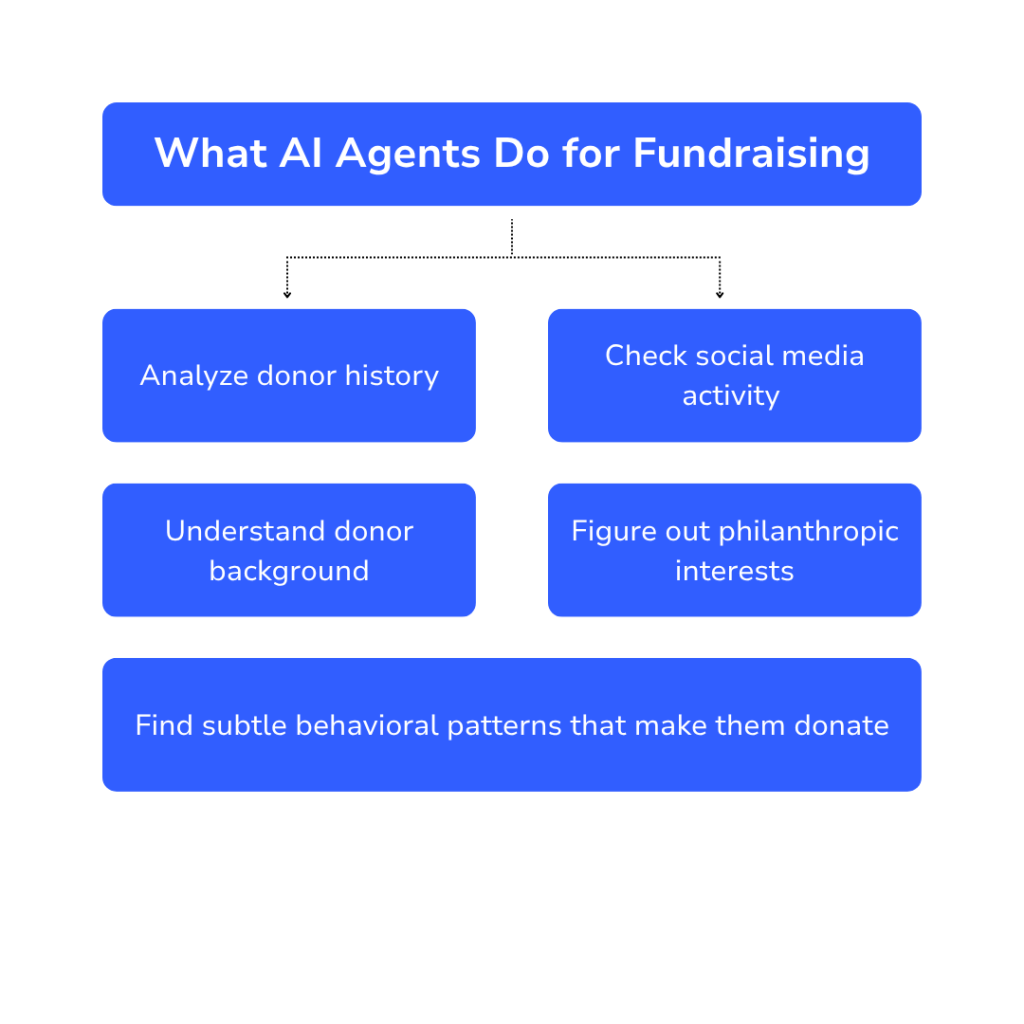
What AI Agents Do for Fundraising

Modern AI agents can analyze thousands of data points about potential donors, such as their: 

  • History
  • Social media activity
  • Professional background
  • Philanthropic interests
  • Subtle behavioral patterns that indicate readiness to give. 

They don’t just crunch numbers; they identify the stories and connections that make fundraising personal.

The Magic of Personalization at Scale

Remember when personalized fundraising meant adding someone’s first name to a mass email? Those days are long gone. Today’s AI agents can create genuinely personalized outreach that speaks to individual motivations, interests, and giving capacity.

How an AI Agent Works: 

Here’s how it works in practice: 

  1. Discovers community concerts: An AI agent might discover that a potential student recently posted on LinkedIn about their dream to further their education, but cannot afford to. 
  2. Connects to your nonprofit: It connects this to your organization’s education research program and suggests not just that this person might be interested, but specifically which program aspects might resonate most deeply. 
  3. Seeks to communicate: The AI might even draft initial talking points that acknowledge their personal connection while respecting their privacy.

The result isn’t manipulation. It’s a genuine connection based on shared values and interests.

“AI helps us find the people who are already looking for us; we just didn’t know how to find each other.”

Research That Used to Take Hours Now Takes Minutes

What AI Agents do is give an edge to fundraising ideas for non-profit organizations. Prospect research traditionally involves hours of detective work across multiple platforms. Development professionals would manually search LinkedIn, company websites, news articles, and giving databases to build a complete picture of a potential donor.

  • AI agents can now perform this research in minutes, not hours. 
  • They scan public records, social media profiles, news mentions, and philanthropic databases simultaneously.
  • They then create comprehensive prospect profiles that would have taken a human researcher an entire day to compile.

AI agents don’t make decisions about who to contact or what to say. It presents information that helps human fundraisers make better, more informed decisions about relationship building.

Timing That Feels Almost Psychic

One of the most impressive capabilities of modern AI agents is their ability to identify optimal timing for outreach. 

  • They analyze donor data patterns in donor behavior, external factors like market conditions or news events, and even seasonal giving trends for fundraising ideas for nonprofit organizations
  • They then suggest when someone might be most receptive to a conversation.
  • For instance, an AI agent might notice that a potential donor typically increases their giving after their company announces strong quarterly earnings. 
  • It can alert development staff to reach out during these windows when the prospect is likely feeling financially confident and philanthropically inclined.

The Email That Doesn’t Feel Like an Email

We’ve all received those painfully obvious mass fundraising emails that immediately trigger our delete reflex. 

  • AI agents are helping organizations create outreach that feels genuinely personal because, in many ways, it actually is.
  • These systems can analyze a donor’s previous interactions, giving history, and stated interests to craft messages that feel like they were written specifically for that individual – because they essentially were. 
  • The AI considers factors like communication style preferences, preferred message length, and even the type of language that historically resonates with similar donors.

The result is outreach that recipients actually want to read, leading to response rates that can be 300-400% higher than traditional mass mailings.

Relationship Building, Not Replacement

Perhaps the most important thing to understand about AI in fundraising is what it doesn’t do.

  • It doesn’t replace genuine human connection. 
  • It doesn’t automate relationship building. 
  • It doesn’t turn fundraising into a purely transactional process.

Instead: 

AI agents handle the time-consuming research and administrative tasks that prevent fundraisers from doing what they do best—building meaningful relationships with people who care about their cause.

“AI doesn’t fundraise for your nonprofit. It gives you the insights and time you need to fundraise more effectively. So you can walk into every donor meeting knowing you’ve done your homework, and can spend more time actually listening and connecting.”

Looking Forward: The Future of Fundraising

While we’ve talked about AI’s potential in fundraising, let me introduce you to something that’s already transforming how smart nonprofits operate: collabAI agents. Think of them as the difference between having a basic calculator and having a financial advisor who never sleeps. As AI technology continues to evolve, we’re moving toward a future where fundraising becomes increasingly strategic and relationship-focused. Organizations using tools like collabAI agents aren’t just raising more money – they’re building stronger, more meaningful relationships with their supporters.

Starting Your AI Journey (Without the Overwhelm)

The beauty of collabAI agents is that you don’t need to transform your entire operation overnight. Most organizations start small:

Week 1-4: Deploy agents just for email timing optimization. Watch your open rates improve as emails land when your specific donors are most receptive.

Month 2-3: Add major gift timing intelligence. Your development officers start having conversations when prospects are most likely to say yes.

Month 4-6: Implement full donor journey orchestration. Every touchpoint is perfectly timed and coordinated.

Ongoing: Track the improvements in donor retention, average gift size, and your team’s efficiency. Most organizations see measurable improvements within the first quarter.

The organizations that embrace this technology now – while maintaining their focus on genuine human connection – will build stronger donor relationships and achieve greater impact than ever before.

If you need experts to guide you on how to use AI agents for your fundraising efforts and nonprofit processes, get in touch with us!

A Guide to Setting Up and Managing Your TutorGPT Dashboard

AI in education is dealing with many learning problems all over the world. As students use AI, there is a shift in how curriculum styles are evolving. The global market for AI in education was valued at $5.88 billion in 2024, and it’s expected to increase to $20 billion by 2027. It really shows how much schools and students are embracing educational assistant technology. These numbers signal a major shift in how students interact with learning materials. 95.6% of students are now using AI tools to help out with their schoolwork. 47.3% of students at Cambridge are using AI chatbots to help tackle their degree requirements. That kind of shift is something educators can’t ignore. 

That said, there are pros and cons of AI in education. While 50% of teachers are using AI for lesson planning, only 24% really feel confident about their understanding of the technology. So, there’s a clear gap there that educators need some solid guidance on how to make the most of these powerful tools. The best use of AI in education will acknowledge that AI should be there to support, not replace, human teaching. It’s about creating spaces where technology improves educational outcomes while making sure personal mentorship is also a priority. This is where platforms like TutorGPT come into play. With TutorGPT, educators can effectively use AI and education while also being mindful of its challenges. Here’s what you need to know about TutorGPT and how to set up and manage its dashboard.

What is TutorGPT?

TutorGPT is an AI-powered educational assistant designed to help students out, especially when their teacher isn’t with them.  With TutorGPT, you get instant guidance and support so that your learning experience flows smoothly. What’s cool is that teachers can use of AI in education to create customized assistants for different subjects, so every student gets help that’s perfect for them. It’s all about making learning more personal and relevant!

And here’s another awesome feature: TutorGPT can fit right into any app or website thanks to its embed code. This means students can tap into its support whether they are learning in the classroom, at home, or anywhere else. TutorGPT is equipped with many specialized assistants so students can always find the help they need, whenever they need it, no waiting around for a teacher to be available. 

https://www.buildyourai.consulting/the-power-of-tutorgpt-embedded-linking-for-seamless-learning
https://www.buildyourai.consulting/the-power-of-ai-in-education-introducing-the-presentation-generator-by-tutorgpt

TutorGPT Dashboard Overview

The TutorGPT dashboard has a variety of controls and features to manage AI assistants and users efficiently. Below is a breakdown of its key components:

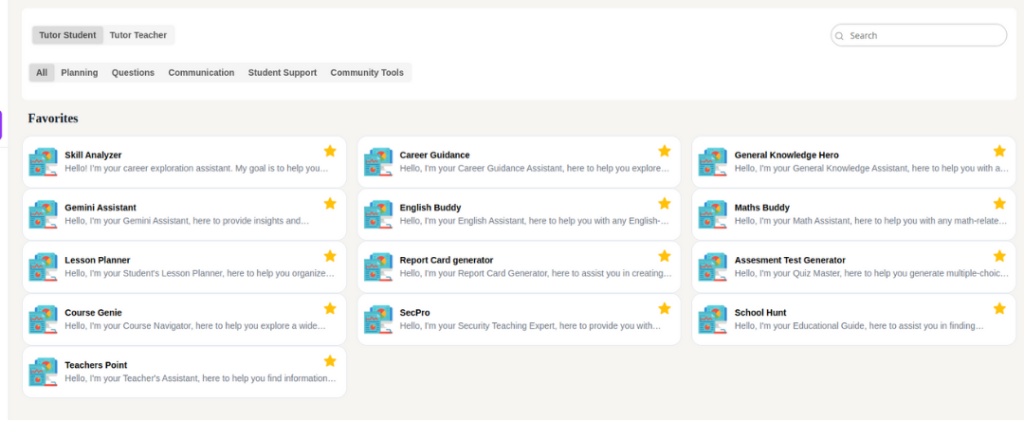
Tutor Tools 

  • Lists all AI assistants available in the system.
  • If accessed from an administrative dashboard, it categorizes assistants for both students and teachers.

User Registration & Login

Getting started with TutorGPT is easy. Whether you’re joining as a tutor or a student, the sign-up doesn’t take much time. 

  • Users can register either as a tutor or a student.
  • There’s a login system that lets you easily access individual user accounts.

My Profile 

  • In ‘My Profile,’ you can see all the user info about yourself, like your name, email, and what role you’re filling (tutor or student). 

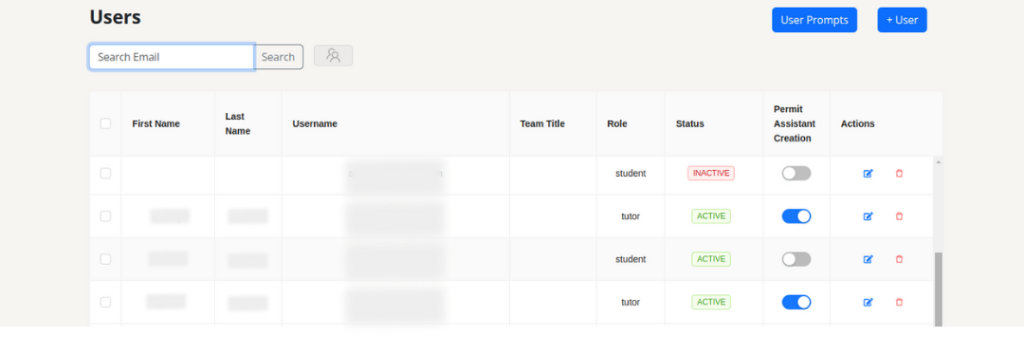
User Section (Admin Access Only)

  • Shows you a complete list of all the registered users and what roles they have.
  • Makes it super easy to create and manage user accounts without any hassle.

Assistant (For Admins and Teachers)

  • Shows All AI Assistants: You’ll get a rundown of all the AI assistants available, and you can see if they’re currently active or turned off.
  • Easy Identification: Each assistant is clearly labeled, making it simple to know what each one does.
  • Shareable URLs: There’s a unique link for each assistant that you can easily share with students, giving them direct access.
  • Embed Code Included: You can grab an embed code to seamlessly integrate these assistants into your websites, making them super accessible.

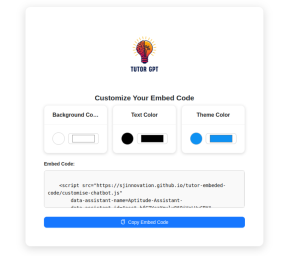
Custom Embed Code

  • Personalize Your Assistant: You can easily change up how your assistant looks, adjusting things like:
    • The text it shows
    • Background colors
    • Overall theme settings
  • User-Friendly Interface: The setup is super straightforward, making it easy to apply these tweaks.

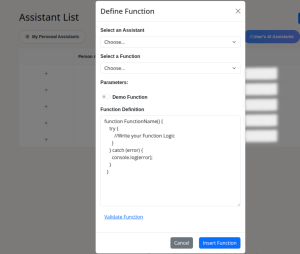
Define Function

  • Special Task Setup: A handy pop-up opens up that lets you give your assistant specific tasks to handle.
  • Customization for Topics: Tailor the assistant to focus on particular subjects or functions.
  • API Integration: You can even connect to APIs to pull in live data, boosting what your assistant can do.

+ Assistant Button

  • Quickly Create New Assistants: This button lets you set up new assistants in no time at all, making the process smooth and efficient.

Student Role Restrictions

  • What Students Can’t Access: Just a heads-up—students won’t have access to:
    • The profile section
    • Creating new assistants
    • Managing user accounts

The Upsides of Educational Assistant Technology

The perks of using AI in education are pretty impressive:

  • Always Available: Get support whenever you need it.
  • Tailored Learning: Instruction that’s personalized just for you.
  • Instant Answers: Quick responses to student questions.
  • Widely Accessible: There’s a chance to bring quality education to even more learners than ever before.

Research from Knewton highlights that students who use AI-enhanced content see improvements, with 62% scoring better on tests. When educators learn to set up and manage these AI-driven tools effectively, they can foster learning environments that blend human insight with the power of artificial intelligence.

Wrapping It Up

TutorGPT is really changing the game of AI in education by offering AI-powered assistance to students whenever and wherever they need it. Its well-organized dashboard, role-based access, and customizable features make the experience smooth and user-friendly for both students and teachers. With options for function calling and embedding, TutorGPT creates an interactive and personalized learning space that truly meets the needs of today’s learners.